INSTITUTE OF PULSE PROCESSES AND TECHNOLOGIES
NATIONAL ACADEMY OF SCIENCE OF UKRAINE
© 2012 Institute of Pulse Processes and Technologies of NAS of Ukraine. All rights reserved.
ELECTROHYDRAULIC TECHNOLOGY OF LUBRICATING COOLANT (LC)
PREPARATION AND GENERATION
APPLICATION OF THE TECHNOLOGY
The technology is developed to prepare the coolant and to increase its service life, to reduce costs for expensive emulsol (oil with emulsifier), and also to improve ecological situation at enterprises.
ESSENCE
The technology is based on the use of energy released during the pulse high-voltage discharge in water. The coolant is exposed to a complex of hydrodynamic, heat, and chemical effects arising during a high-voltage discharge in the electrohydraulic installation. The maximum emulsol dispersion in water and a high bactericidal effect are thus achieved.
APPLICABILITY OF THE TECHNOLOGY DEVELOPMENT
- strict requirements to safe operation with lubricating coolants (LC) during blade treatment of metals and polishing, ecological regulations on prohibition of environmental pollution with toxic wastes of industrial enterprises have caused prohibition of nitrites, formaldehyde, heavy metal, secondary amines, diethanolamine, nitrosamine, biphenyls, terphynyls and dioxide containing substances as LC components. These components are to date the basics of the most widely spread synthetical LC;
- since 1978 Switzerland has been developing ecologically pure and safe LC of ISO 2001 and ISO 14001 standards. These fluids have an advantage: they are made from mineral oil base. Oil and water are the best combination for safe LC. The first component provides for good lubricating properties, and the second ensures good cooling of the instrument and the part. But emulsifiers are also not the less important part of water-oil LC. Physicochemical stability of emulsion in water is possible due to them;
- emulsifiers are necessary in LC, but with time they cause malfunction of emulsion biological stability and promote the growth of anaerobic bacteria, formation of different fungus colonies which are dangerous for breathing being a component of LC vapors.
ELECTRICAL DISCHARGE AND ITS COMPLEX ACTION ON LC COMPONENTS
High-voltage electric discharge in water, oil and emulsifier mixture results in:
- efficient dispersion of oil in water. After electrohydraulic (EH) treatment, 95% of oil component in emulsion has a form of smallest drops with maximum sizes 6 -10 µm having long resistance to fusion and eliminating emulsion division into phases;
- higher solubility of the emulsifier and its higher action on stability of physicochemical properties of the emulsion;
- electromagnetic radiation of a sparkle discharge, shock waves, cavitation and rigid light radiation produce a bactericidal effect on LC and eliminate formation of pathogenic bacteria and fungi;
- improved working lubricating-cooling performances of LC after each EH treatment.
Equipment for LC preparation and regeneration
PREPARATION
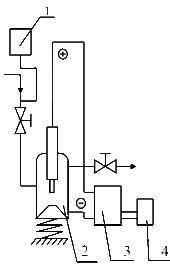
Emulsol (oil with emulsifier) from the doser 1 together with water comes to the discharge chamber 2. Simultaneously from the high-voltage generator of pulse currents 3 enabled by the control panel 4 high voltage is supplied to the electrodes of discharge chamber 2 in which the LC components intensively disperse during electric discharges.
REGENERATION
After cleansing against mechanical inclusions, the waste LC goes to the discharge chamber 2, then enriched through the doser 1 with some small amount of fresh emulsol and next EH treated. LC with regenerated properties is obtained at the chamber output.
ENGINEERING AND ECONOMY RATES OF THE EQUIPMENT:
ADVANTAGES OF A NEW TECHNOLOGY:
Technological process and EH equipment for preparation and regeneration of water-oil LC have the following advantages over existing hydrodynamic, mechanical and vibration methods:
- high stability of LC properties during long-time operation. Resistance to emulsion separation into oil and water phases 2.5-5 times exceeds standard rates;
- bactericidal action of the electric discharge which allows for refusal of expensive, harmful chemicals and preventing chemical-biological destruction of LC;
- nearly 2.7 less energy costs as compared to the most popular among the known methods of water-oil LC preparation methods;
- rather easier regeneration process of the waste LC with no prior separation of emulsion into oil and water components;
- possibility to prepare LC of different composition and purposes without reconfiguring the equipment by choosing the treatment mode which can be changed in a wide range of parameters.
Phones: +38 (0512) 58-71-48